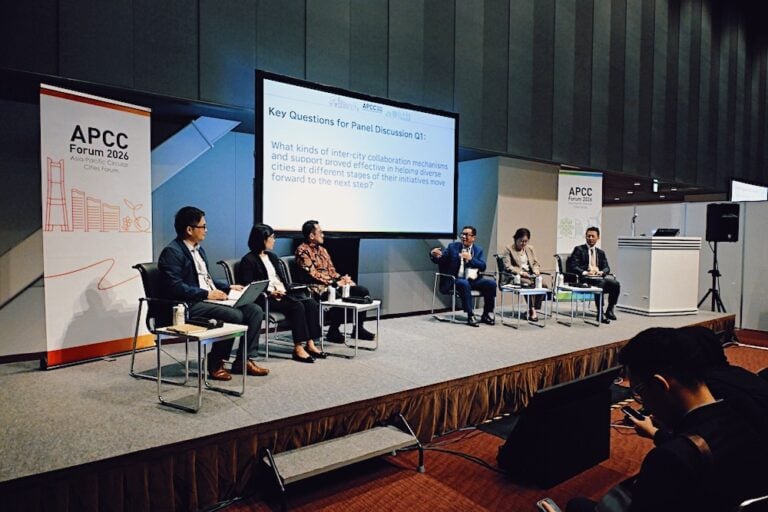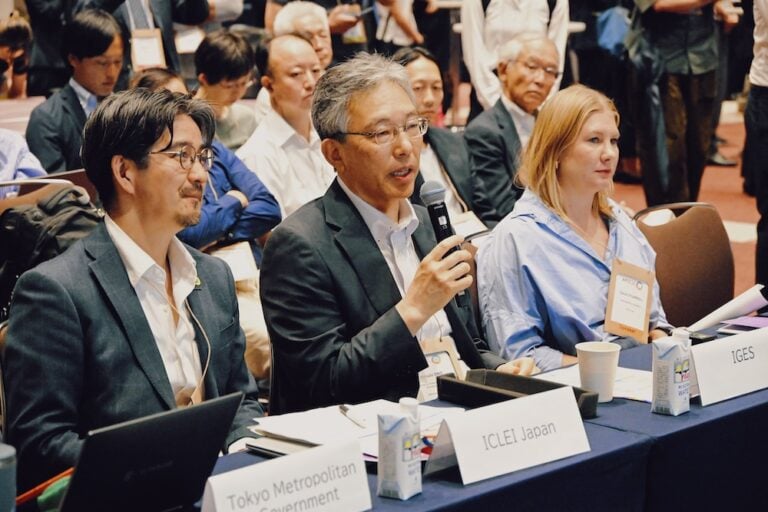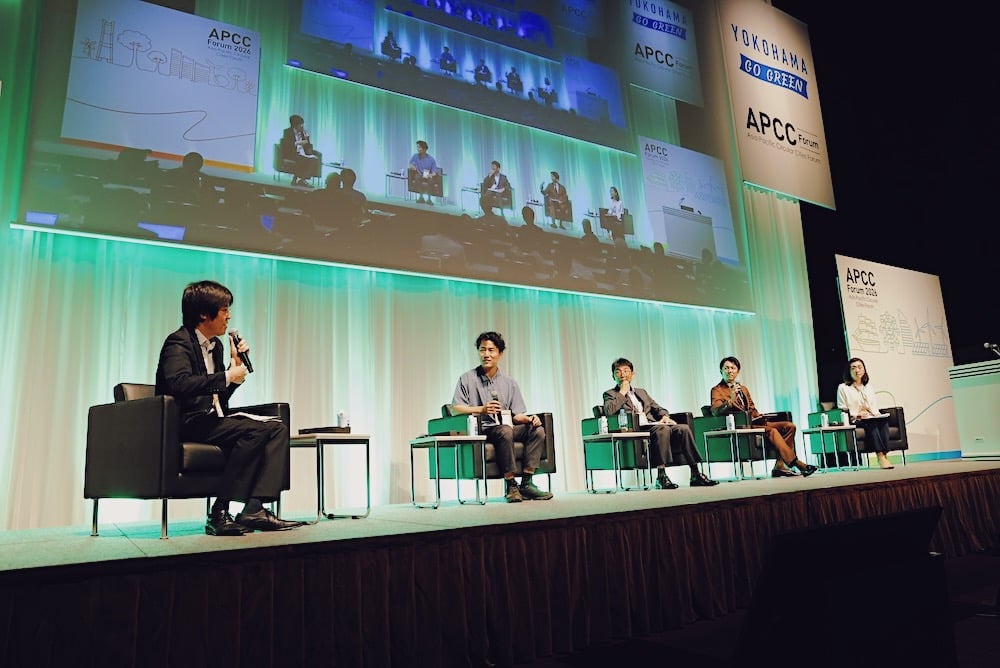
As businesses work toward a circular economy transition, cities are being called upon to play a more active supporting role. The functions cities are expected to provide—from building collection and recycling infrastructure for a stable supply of recycled materials, to sharing resource circulation data and creating pilot environments through public-private collaboration—are expanding well beyond traditional waste management.
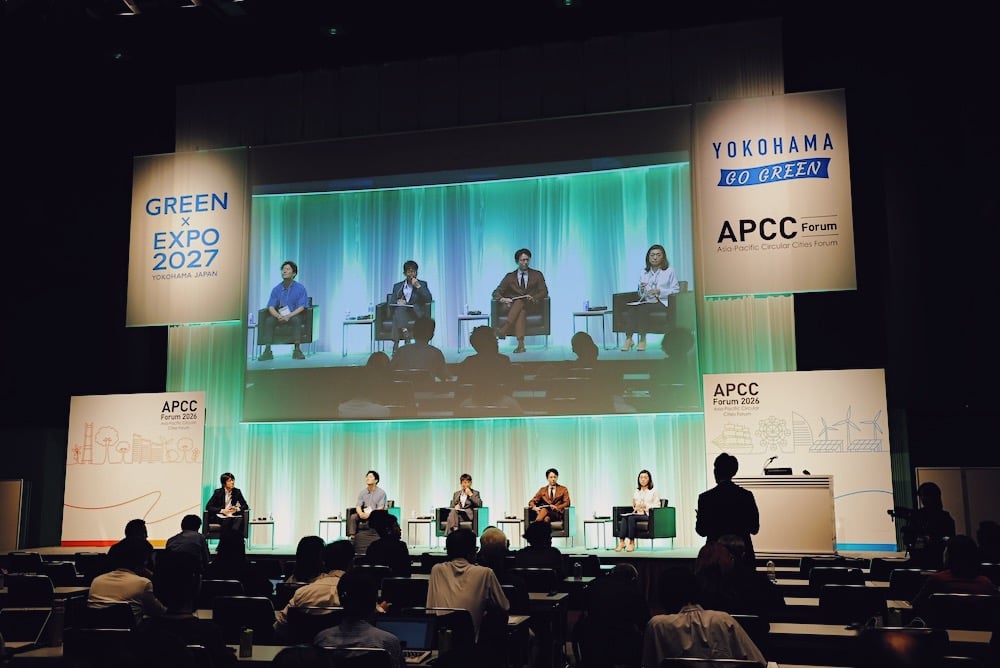
In September 2026, the Asia-Pacific Circular Cities Forum (APCC-Forum) was held in Yokohama. At the second day’s business sector session—”Industrial Transformation toward a Circular Economy and the Role of Cities: What Do Circular Economy Companies Need from Cities?”—companies working on circular economy initiatives in fields such as architecture, manufacturing, packaging, and digital technology shared practical case studies. Drawing on each company’s experiences and challenges, participants discussed what kind of city can support a circular industrial structure, and what possibilities exist through collaboration between businesses and local governments.
Yokohama’s Circular City Strategy: Six Perspectives Connecting Industry and Resources
At the opening of the session, moderator Yu Kato (加藤佑) of the Circular Future Design Center at Zenseikan Graduate School introduced the “Transition to a Circular City” initiative—one of the cross-cutting projects in the City of Yokohama’s four-year plan, the Yokohama City Medium-Term Plan 2026–2029, formulated in 2026.
Kato highlighted three key elements for advancing these efforts: the city’s scale of approximately 3.7 million residents, the importance of finding new value in existing resources from diverse perspectives, and citizen participation. “If we can see waste as a resource,” he said, “it becomes an opportunity for new circular businesses, innovation, and solutions.”
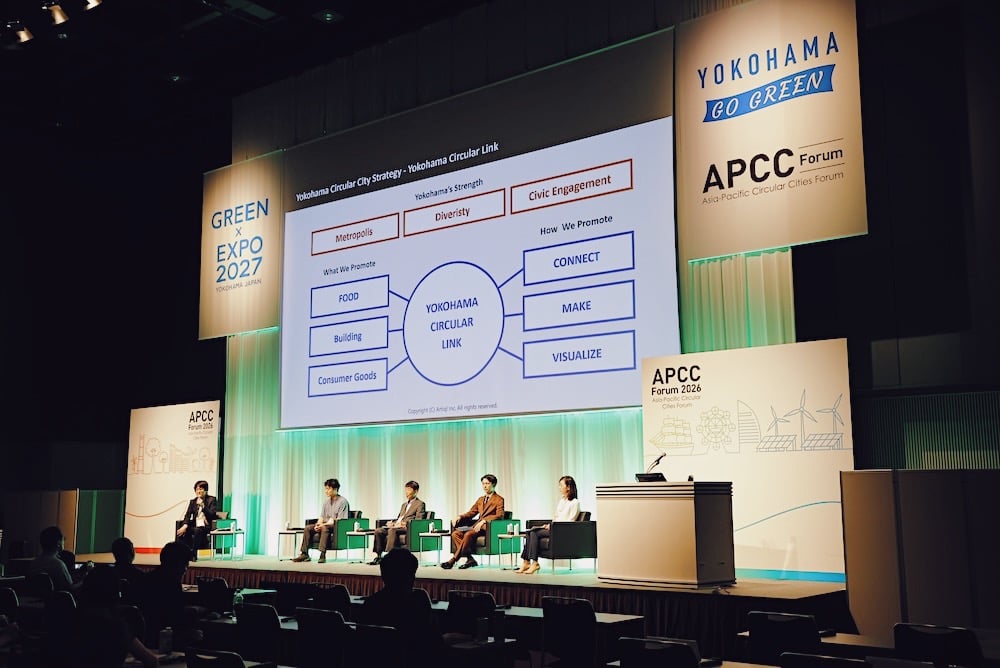
The strategy focuses on six priority areas: three sectors—food, architecture, and consumer goods—combined with three approaches: building circular value chains that connect recyclers and manufacturers (Connect), promoting circular design and manufacturing through collaboration with local SMEs and large corporations (Make), and visualizing material flows across the entire city (Visualize).
Kato noted that the session’s speakers covered these areas broadly. Against the backdrop of Yokohama’s urban strategy, each company shared its resource circulation practices and the challenges it faces.
Exploring the Potential of “Asian Circular Architecture” Through Local Culture and Material Characteristics
The first speaker, Genki Unno (海野玄陽) of Takenaka Corporation, highlighted the importance of “Circular Design-Build”—an approach that treats the entire lifecycle of a building, from resource extraction to demolition and disposal, as the scope of design, in order to realize a circular economy in the construction sector.
The extraction and processing of natural resources is linked to more than 55% of global greenhouse gas emissions and over 90% of biodiversity loss. The construction industry, which consumes large quantities of resources and generates significant waste from building and demolition activities, is one of the sectors most in need of transformation toward resource circulation.
Takenaka Corporation has set targets to reduce landfill waste by 10% by 2030 and to zero by 2050, and is advancing efforts through the creation of a circular design guidebook and initiatives in new construction and renovation projects.
Unno’s key argument was that circular architecture should prioritize not only extending the lifespan of materials, but also enabling the replacement and reuse of components in ways that reflect local culture and material characteristics. In Europe, a “stone culture” has given rise to an architectural tradition of using highly durable materials over long periods and reusing them, based on the premise that materials do not deteriorate.
Japan, on the other hand, has its own tradition exemplified by the Shikinen Sengu at Ise Jingu—the periodic rebuilding of shrine buildings every 20 years, with the old timber repurposed for constructing torii gates or restoring shrines damaged by disasters. This practice of renewing building materials while maintaining historic structures offers many insights for the transition to circularity.
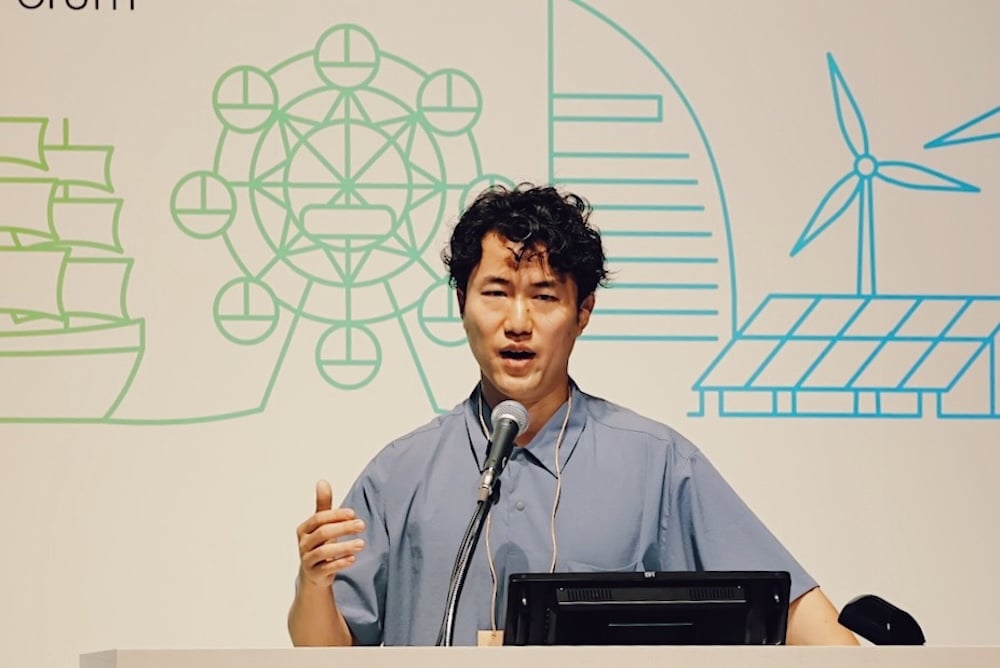
Unno also drew attention to bamboo architecture in Indonesia. Because local craftspeople can replace bamboo components—and the removed bamboo can be repurposed for other uses—he sees strong potential for resource circulation that draws on local skills and culture.
“The architectural form, systems, and philosophy are passed down, while local craftspeople can replace the components as many times as needed,” Unno said. He emphasized that combining materials such as bamboo and timber with local techniques and culture—while also integrating them with concrete and steel—represents one pathway for advancing the circular economy across Asia.
From the Use of Recycled Materials to Comprehensive Resource Circulation
Hisashi Harada (原田久) of Yamaha Motor Co., Ltd. introduced the company’s environmental plan and its initiatives toward resource circulation. The company’s environmental plan through 2050 identifies three priority areas: climate change, the circular economy, and biodiversity.
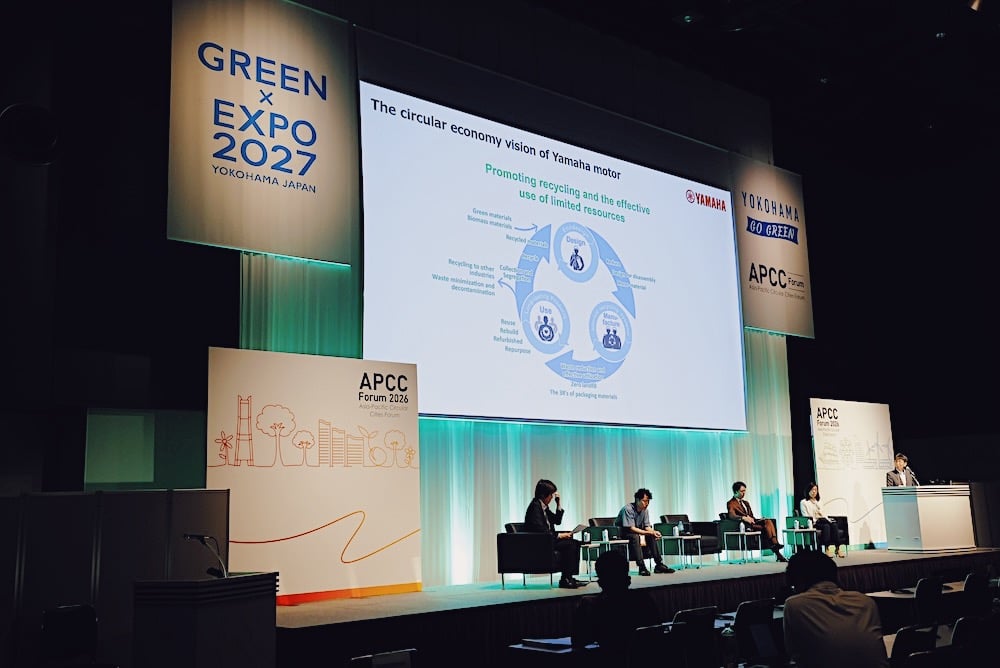
On resource circulation, the company has set targets to replace virgin materials with recycled alternatives—30% by 2035 and 100% by 2050.
Efforts to achieve these targets are grounded in the 3Rs: reducing raw material and energy consumption throughout the manufacturing process and across the product lifecycle (Reduce); promoting product reuse and extended use (Reuse); and recycling raw materials and components back into the production cycle (Recycle).
Harada cited specific examples, including the adoption of environmentally friendly recycled polypropylene in motorcycles and the use of green aluminum. The company is also developing reinforced resins made from bio-derived materials such as cellulose nanofibers for use in certain parts of personal watercraft.
At the same time, he acknowledged ongoing challenges: understanding how products are used, repaired, and recycled after sale; enhancing the customer value of circular products; and establishing systems to channel recovered resources back into the same category of products.
“Establishing a closed-loop recycling system for motorcycles remains a challenge,” Harada noted. He went on to outline the company’s intention to promote the reuse and remanufacturing of motorcycles and parts, aiming for resource circulation across the entire product lifecycle.
Visualizing Waste Data to Drive Private Investment in Resource Circulation
Next, Takuki Omura (大村拓輝) of Recotec Co., Ltd. argued that building systems to collect and utilize urban waste data is key to attracting private investment toward a circular economy. “Without data, funding won’t follow,” he said, stressing the importance of continuously tracking the type, volume, quality, and origin of waste.
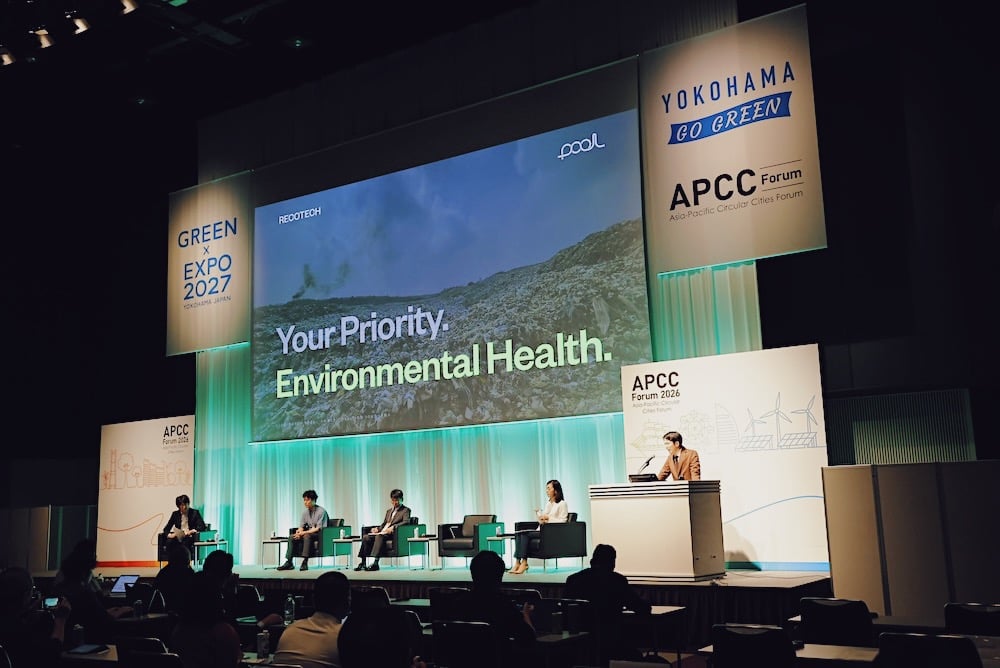
In many Asian cities, maintaining environmental sanitation through waste management remains a top priority. At the same time, developing landfill, incineration, and recycling facilities requires substantial investment. Attracting private capital to such infrastructure requires data to assess investment risk. Without a clear picture of waste generation, it is difficult to plan facility locations, collection routes, and operating rates appropriately—making it hard for financial institutions to make informed investment decisions.
Omura called on cities to establish, as a matter of urban policy, systems for continuously collecting primary data at the point where waste is generated.
The cloud-based waste weighing and management system “pool,” developed by his company, connects the three stages of waste generation, collection, and procurement through data. In Yokohama, it has been deployed at approximately 1,200 locations and is used to record and manage waste weight, type, and origin. In addition to reducing the burden of manual record-keeping, the shared use of the system by waste generators, collectors, and local government has contributed to optimizing collection routes and streamlining reporting processes.
Omura further urged that waste be understood as a resource distributed throughout the city, and that resource circulation be considered from the perspective of economic security.
“Beneath our cities, resources are distributed like oil fields,” he said. “What we need to tap into them is data.” He outlined a vision of using data infrastructure to attract private investment and transform cities from mere consumers of resources into suppliers—shifting the paradigm of urban resource management.
Advancing Resource Circulation for Paper Cartons Through Collection Systems and Demand for Recycled Products
Yuko Omori (大森悠子) of Tetra Pak Japan described the company’s efforts to advance resource circulation for paper cartons—not only by expanding domestic collection points and raising consumer awareness, but also by developing markets for products made from recycled materials.
The company takes an integrated approach to packaging, from carton design through collection and recycling, with the goal of keeping materials in use for as long as possible. She shared 2025 achievements, including the collection and recycling of approximately 1.3 million cartons worldwide, and a case study in which reducing aluminum content in juice cartons and replacing it with paper-based materials cut the carbon footprint of the packaging alone by approximately 23%.
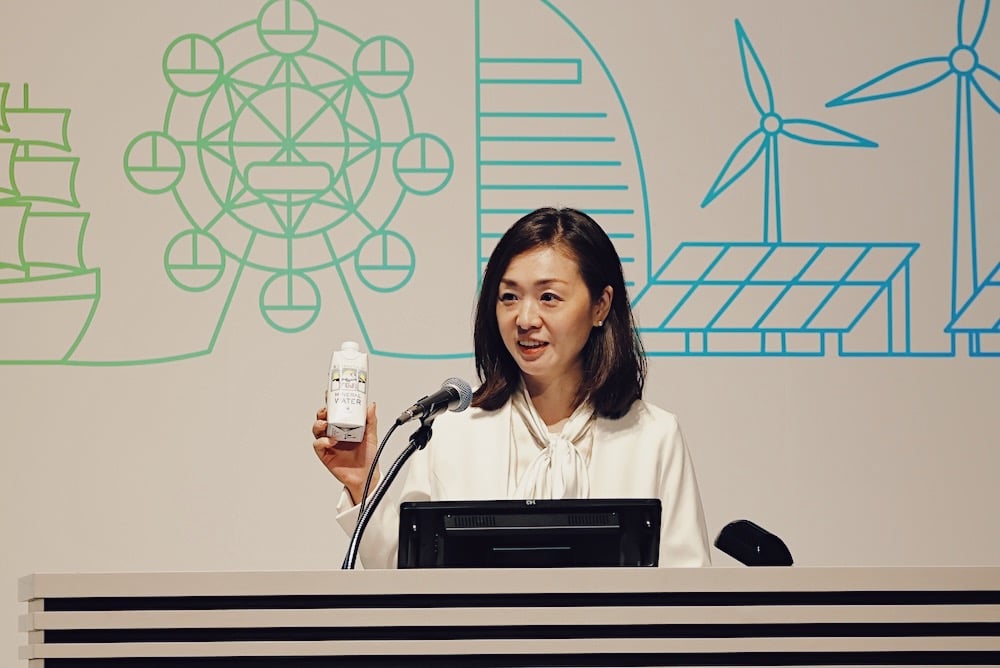
Meanwhile, the collection rate for used paper cartons in Japan stands at only around 30%(※). According to Omori, approximately half of what is collected comes through in-store collection at supermarkets, and expanding collection opportunities—in combination with municipal collection—remains a key challenge.
“Circulation begins with collection, and collection begins with consumers,” Omori said, pointing to the need to raise awareness of paper carton recycling and to increase the touchpoints through which consumers can access information, in partnership with local governments and other stakeholders.
The company is also developing high-value-added products made from recycled materials. Rather than simply encouraging collection, the aim is to generate demand for products made from recycled content, thereby sustaining and expanding resource circulation over time.
Barriers to Resource Circulation That No Single Company Can Overcome Alone
The subsequent panel discussion drew on each company’s experiences to examine the obstacles hindering the spread of circular business models and the role that cities and local governments are expected to play.
Takenaka Corporation’s Unno pointed to the challenge of shifting perceptions around recycled and reused materials in the construction sector. A persistent image of such materials as low-quality and unrefined makes them difficult for building owners to accept. Yamaha Motor’s Harada, meanwhile, cited the difficulty of balancing cost and quality when introducing recycled materials, as well as the challenge of building internal consensus within the company.
Recotec’s Omura highlighted the importance of designing incentives to encourage waste data collection and ensuring sufficient data scale. Without direct benefits that justify the effort of data entry, corporate participation is hard to secure—and the burden on early adopters is heavy during the network’s launch phase. The time it takes for data to generate value is also a factor that slows adoption.
Tetra Pak Japan’s Omori identified collection as a core challenge. Paper cartons are lightweight, but because they are consumed across widely dispersed locations, collecting them independently is transport-inefficient and economically difficult to sustain. She noted the need to build new collection systems that leverage existing in-store collection networks, while simultaneously advancing the development of recycled products.
What these challenges share is that they are difficult for individual companies to resolve on their own. The discussion surfaced expectations for cities and local governments to play roles in establishing regulations and economic incentives, facilitating cross-sector collaboration, and educating and raising awareness among consumers.
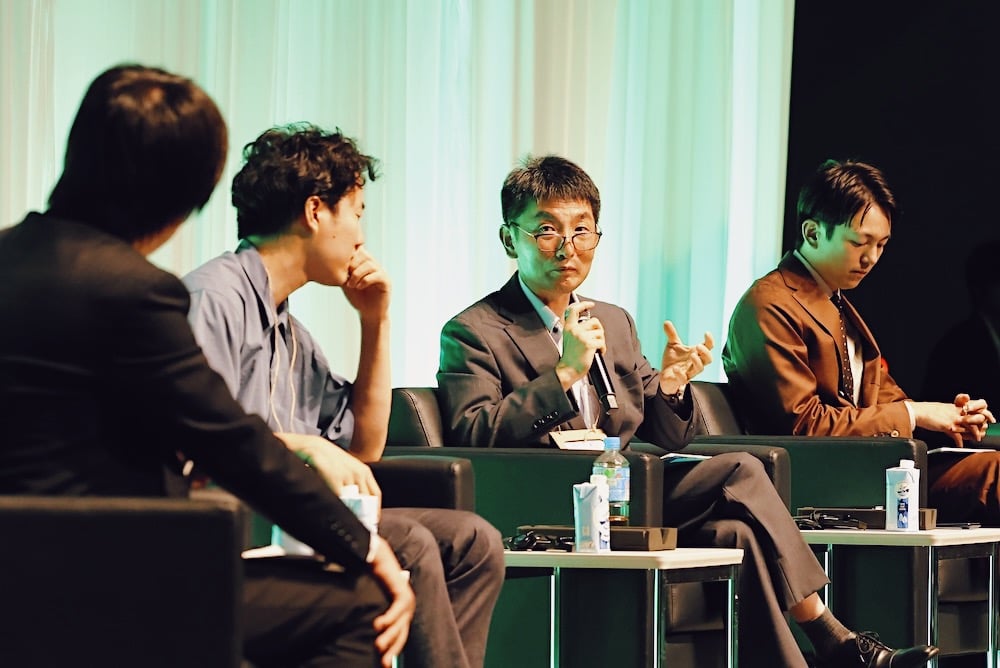
Unno proposed that “government evaluation systems” and “collaboration” are essential to addressing these challenges. For example, repurposing aluminum recovered from the automotive industry for use in construction could open new applications for the material. Advancing such cross-sector linkages, he argued, requires government support and the creation of opportunities for companies to collaborate.
Building on this, Harada noted that making higher-value use of recycled materials such as steel and aluminum recovered from other industries would also require collaboration with recyclers and others in the value chain. He acknowledged that while his company already uses a significant amount of recycled material, creating customer value for sustainable products remains an ongoing challenge. He also raised the need for education and awareness programs—developed in collaboration with cities and local governments—to strengthen public understanding of resource circulation.
Omura cited the deployment of “pool” at Tamagawa Takashimaya, which has more than 300 tenants, as an example of how “public-scale adoption generates private-sector incentives.” He proposed building a shared data infrastructure at the city scale. If waste data can be aggregated to identify where resources are located and assess their quality, it becomes possible to make effective use of resources distributed throughout the city. Achieving this, he said, requires establishing rules to bring more participants on board.
Omori called on local governments to introduce policies that promote collection and support the use of recycled materials. She argued that there are limits to what private companies can achieve in collection on their own, and that government support and regulatory frameworks are essential to accelerating resource circulation. She also introduced examples from overseas where recycled materials derived from paper cartons are used in building materials such as plasterboard and roofing, suggesting that with government support, cross-sector collaboration could open up new markets.
In closing, Kato emphasized that education plays a vital role in cultivating future markets for circular products and services. Cities and local governments can broaden public understanding through public education. He concluded the discussion by noting that supporting the transition to a circular society through collaboration with businesses is key to realizing a circular future across the Asia-Pacific region.
From Individual Corporate Efforts to City-Wide Resource Circulation
This session made clear that scaling up circular economy practices requires not only technological development and management effort on the part of companies, but also the social systems needed to support them.
The quality and price of recycled materials, their value to customers, the efficiency of used-product collection, and the mechanisms needed to encourage participation in data collection—the challenges each company faces differ, but most cannot be resolved by any single company alone. There is a need to connect supply and demand for recycled materials, share the burden of collection, and create the conditions under which circular products and services are chosen in the marketplace.
The policies of cities and local governments are the critical interface for making this happen. Common rules and financial support can lower barriers to entry for businesses; enabling materials and data to flow between different industries creates the environment for cross-sector resource use; and education and awareness-raising among citizens can generate demand for circular products. What is needed is the construction of a foundation that connects individual corporate initiatives to city-wide resource circulation.
Translating what is technically feasible into something economically viable and sustainable requires asking how corporate practice and urban policy can be effectively linked. As cities and local governments put in place regulatory frameworks and support measures, and as they facilitate collaboration between companies and encourage citizen participation, the conditions for circular business to flourish will continue to evolve. Today’s discussion posed a renewed question: what kinds of systems must cities build, and how can they connect industry and society, in order to scale individual corporate efforts into city-wide resource circulation?
【Reference Article】What Do Circular Economy Companies Need from Cities? Insights from Architecture, Manufacturing, Packaging, and Data [APCC2026 Report] | Circular Economy Hub
【Reference Site】Asia-Pacific Circular Cities Forum 2026 (APCC-Forum 2026)
【Reference Site】※ Paper Carton Recycling Flow and Trends in Collection Rates | Japan Milk Carton Environmental Council
【Related Article】A Circular Economy That Starts with Cities: The Asia-Pacific’s First Steps from Declaration to Action [APCC2026 Report]
【Related Article】The Asia-Pacific Takes on Plastic Pollution: The Future of the Global Treaty and Practical Knowledge from Cities and Local Governments [APCC2026 Report]
【Related Article】City-to-City Collaboration Connecting the Asia-Pacific Circular Economy: Where Bangkok, Makassar, and Cebu Stand Today [APCC2026 Report]
※This article is republished from Circular Economy Hub, operated by Article Inc.