Scaling the circular economy across society requires not only corporate technology development and product design, but also mechanisms that create markets where circular products and recycled materials are actively chosen. One such mechanism is public procurement and evaluation frameworks by local governments.
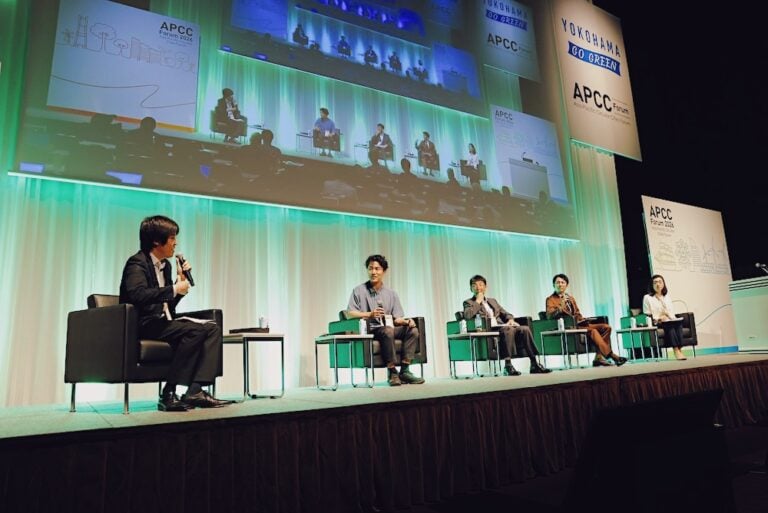
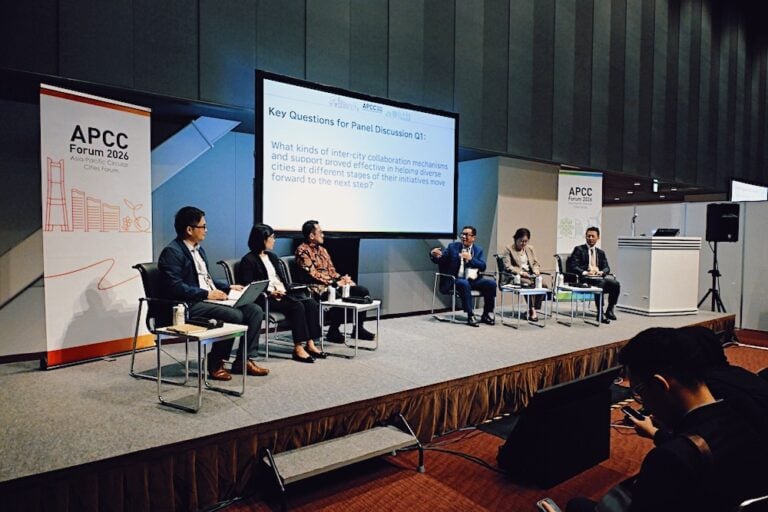
In September 2026, on the second day of the Asia-Pacific Circular Cities Forum (APCC-Forum) held in Yokohama, a public-private dialogue session was convened under the title “Potential for Linking Municipal Policy and Business Activity to Accelerate the Circular Economy: Public Procurement, Supply Chain Development, and Advanced Resource Circulation.” Building on discussions from the business sector session, this session focused on how local governments can foster market formation. Officials from the City of Yokohama and corporate speakers explored the potential for aligning municipal policy with business activity across three themes: “circular architecture,” “business support,” and “resource circulation DX.”
Horizontal Recycling of Building Materials and Design for Longevity
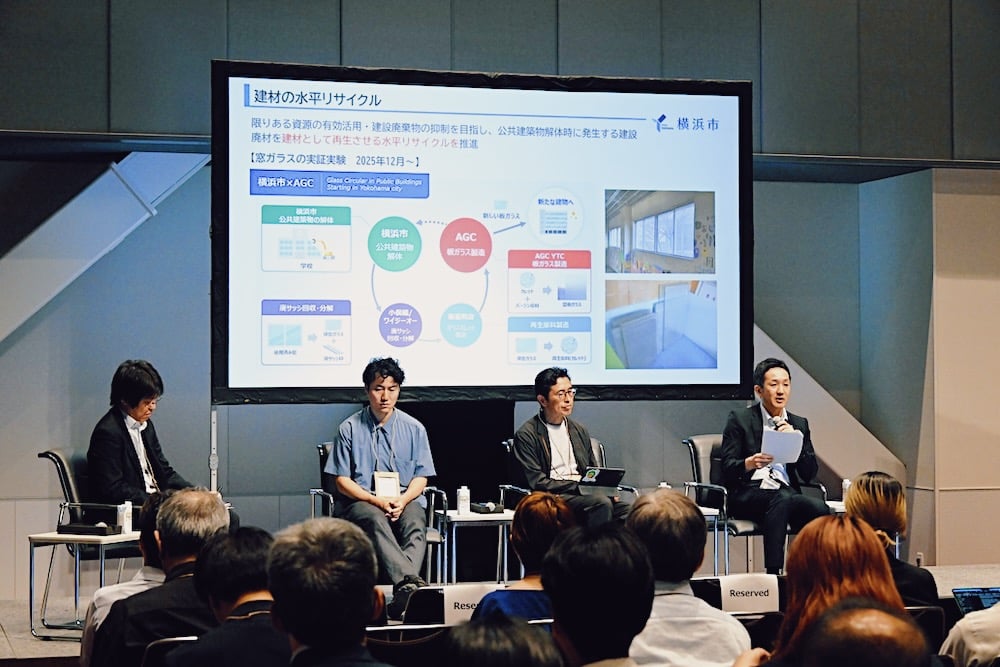
The first theme was “circular architecture.” Susumu Sone (曽根進) of the City of Yokohama’s Architecture Bureau, Public Buildings Division, defined circular architecture as “architecture that aims for resource circulation and waste reduction through measures such as extending building lifespans, using timber, and reusing building materials.” He identified three pillars for circular initiatives in public buildings: extending the lifespan of existing structures, utilizing bio-based materials such as timber and other renewable resources, and designing for ease of deconstruction.
One concrete initiative is a horizontal recycling program for window glass, developed in collaboration with AGC Inc. Since December 2025, the City of Yokohama has been conducting a demonstration project with the company to reuse window glass generated from building replacements and renovations as new construction materials. The city plans to expand the program to include aluminum sashes, gypsum board, and carpet tiles in partnership with other businesses.
Another initiative, the “REYO (Riyō) Yokohama City Reclaimed Materials Project,” repurposes flooring materials removed during gymnasium renovations at city schools into wall panels, benches, and other elements in different buildings. With approximately 500 schools in the city and around ten gymnasiums renovated each year, the scale of potential impact is significant. Sone remarked, “We want to carry forward not just waste reduction, but also the stories and history embedded in public buildings as a form of value.”
Expanding these initiatives requires collaboration across the entire supply chain, including manufacturers, contractors, and demolition companies. Sone emphasized the need for public-private partnership, stating, “It is difficult for a local government to advance circular projects like these on its own. I have come to realize that collaboration with the private sector—manufacturers, contractors, and demolition companies—is essential.”
The City of Yokohama is currently considering the development of design standards that evaluate the use of recycled and horizontally recycled building materials, building longevity, and ease of renovation and deconstruction. The aim is to incorporate circularity indicators into the procurement conditions for public buildings, thereby promoting the adoption of circular architecture.
Next, Osamu Furuichi (古市理) of Taisei Corporation introduced “T-FIELD/SATTE,” a circular economy building the company developed in Satte City, Saitama Prefecture. He presented the concept of a “Vortex Economy”—a circular system that connects regional industries in a swirling flow, embodied by this facility. Because different components of a building have different service lives, the goal is not to circulate building materials solely within the construction sector, but to create a system that also draws on resources generated by other industries and circulates them within the region.
Furuichi explained, “General contractors have traditionally been part of the arterial industries focused on inflows, but going forward we aim to integrate venous industries and pursue arterial-venous collaboration.” The facility makes use of timber from Chichibu, horizontally recycled glass, and cardboard laminated with aluminum foil for fire resistance. In addition to introducing a “circular design rate” to evaluate resource circularity at the design stage, the project pursues both resource circulation and decarbonization across the building’s entire lifecycle through the use of electric construction machinery, biofuels, and on-site solar power generation.
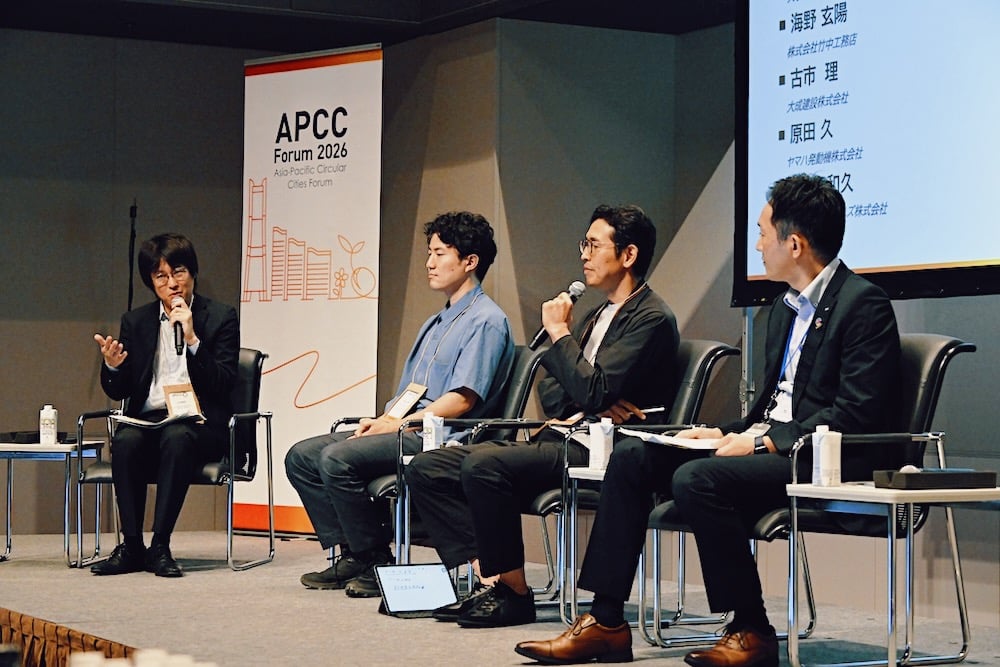
Genyo Unno (海野玄陽) of Takenaka Corporation pointed out that making buildings last longer requires not only material reuse, but also design that anticipates future repairs and changes in use. Unno noted that his approach to circular architecture focuses on “building redundancy,” citing examples such as bamboo architecture in Indonesia to explain how enabling people beyond the original designers and contractors to understand a structure—and to carry out repairs or deconstruction—contributes to circularity.
He also noted that even physically durable buildings can be demolished if their design no longer meets the needs of the times. According to Unno, timber buildings tend to have lower durability yet are used for relatively long periods, while concrete buildings are highly durable yet tend to be demolished sooner than timber ones. He suggested that building in flexibility for future changes of use could be a pathway to circular architecture, adding, “I would be glad if we could work together to develop approaches that align social lifespan with physical lifespan.”
Building Systems That Support Corporate Innovation and Generate Circular Businesses
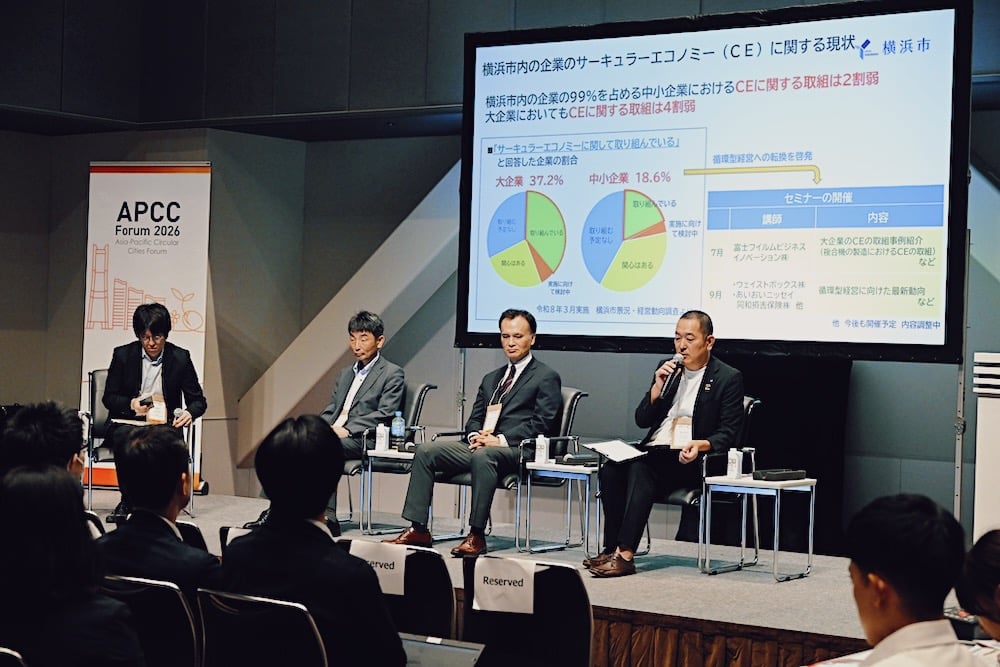
The second theme was “business support.” Koji Kaji (梶晃三) of the City of Yokohama’s Economic Affairs Bureau, Planning Division, presented the current state of circular economy engagement among city businesses and the support measures in place, under the title “Building a Circular Supply Chain Starting from Corporate Structural Transformation.”
According to a City of Yokohama survey, only 37% of large enterprises and 18% of small and medium-sized enterprises are actively working toward the circular economy. To enable more companies to engage, the city provides comprehensive support spanning seminars on leading practices and the latest trends, through to technology development, demonstration projects, social implementation, inter-company collaboration, and business expansion.
Kaji highlighted the city’s strengths as including a diverse industrial base spanning manufacturing to services, technical experts and researchers from universities and research institutions, and a market backed by a population of approximately 3.76 million. The goal is not merely to support individual companies, but to foster an environment where inter-company collaboration flourishes and circular businesses can emerge. Kaji stated, “Rather than simply providing subsidies as a local government, we want to be a player that works alongside companies willing to take on challenges and helps build circular supply chains together.”
Kazuhisa Kumano (熊野和久) of Dassault Systèmes K.K.—a software company headquartered in the suburbs of Paris, France—introduced the use of digital technologies to support product design, manufacturing, and supply chain management. By leveraging the company’s strength in 3D design technology to simulate product performance and durability digitally, he explained, it is possible to reduce the resource consumption associated with prototype manufacturing and testing while shortening development timelines.
Kumano cited the European battery passport as an example of regulations and frameworks driving corporate transformation. He noted that incorporating circularity criteria into municipal public procurement and subsidy evaluation is one way to encourage corporate action. Regarding support for small and medium-sized enterprises, he proposed that combining training and onboarding programs with subsidies—rather than focusing solely on certification—could make it easier for more companies to get involved.
Hisashi Harada (原田久) of Yamaha Motor Co., Ltd., meanwhile, outlined the challenges of resource circulation in durable consumer goods. At his company, which handles mobility products such as motorcycles and bicycle components, most end-of-life products are left to open recycling driven by market forces, and a closed loop that returns materials to the company’s own manufacturing processes has not been established. Although Japan’s domestic motorcycle industry has a voluntary recycling scheme operated by manufacturers, the number of vehicles entering the recycling stream amounts to only about 1% of new vehicle sales.
The company’s goal is to design products for longevity and create systems that pass used products on to the next user as secondhand goods. Because motorcycles require lightweight construction, efforts to reduce material use are already underway. However, vehicle bodies tend to be discarded when consumers upgrade to new models, and while some used vehicles do circulate in the secondhand market, domestic demand for them is limited. Simply manufacturing and selling products, he noted, does not readily translate into resource circulation.
Harada said that while the company is committed to extending product lifespans and promoting reuse, it looks to local governments to develop frameworks for returning waste to resources and to provide support for businesses. He also pointed out that many products still depend on replacement demand, and argued that achieving the circular economy requires not only offering products that maintain customer value, but also consumer education and awareness-raising to shift mindsets from disposability to circularity.
Responding to these discussions, Kaji remarked, “While it is difficult for government to build supply chains itself, we may be able to create spaces where companies and citizens meet and co-create.” He indicated the city’s intention to support the creation of circular businesses by facilitating inter-company collaboration while also keeping an eye on shifts in citizen awareness and behavior.
Connecting Logistics and Data to Streamline Resource Circulation at the Local Level
The third theme was “resource circulation DX.” Takashi Oshima (大島貴至) of the City of Yokohama’s Resource Circulation Bureau identified a key challenge in advancing resource circulation: the fact that waste and recycled resources are subject to different regulatory frameworks and cost-sharing arrangements. He explained the need to improve logistics efficiency and ensure a stable supply of resources.
Between the “arterial industries” that manufacture and sell products and the “venous industries” that handle waste processing and recycling, there exists a logistics layer responsible for moving resources. When materials are treated as waste, collection and transport operators must hold the appropriate permits, and waste generators bear responsibility for proper disposal. When materials are traded as recycled resources, however, different rules apply. Oshima noted that these distinctions are a critical consideration when thinking about logistics for resource circulation.
For example, when used PET bottles generated by businesses are treated as waste, the generating business must typically commission their disposal through individual contracts with processors. This disperses collection points and makes it difficult to aggregate resources efficiently. To address this challenge, the City of Yokohama has taken on a coordinating role in a “bottle-to-bottle” horizontal recycling initiative in the Minato Mirai 21 district, in which used PET bottles are recycled into new PET bottles.
In this initiative, the General Incorporated Association Yokohama Minato Mirai 21, which manages the area, serves as the central coordinator, with 30 facilities in the district participating. Participants sort and discharge PET bottles in a condition suitable for recycling as recovered resources—for instance, by ensuring bottles are emptied of any remaining liquid. Collection is carried out in consolidated rounds visiting each facility, and the bottles are compressed and baled to enable efficient transport by large vehicles. This approach reduces collection and transport costs and establishes a system through which beverage manufacturers and recycling operators can procure the materials as recycled resources. Oshima explained that aggregating resources at the area level rather than the individual facility level makes it possible to secure sufficient collection volumes, ensure stable supply, and reduce costs.
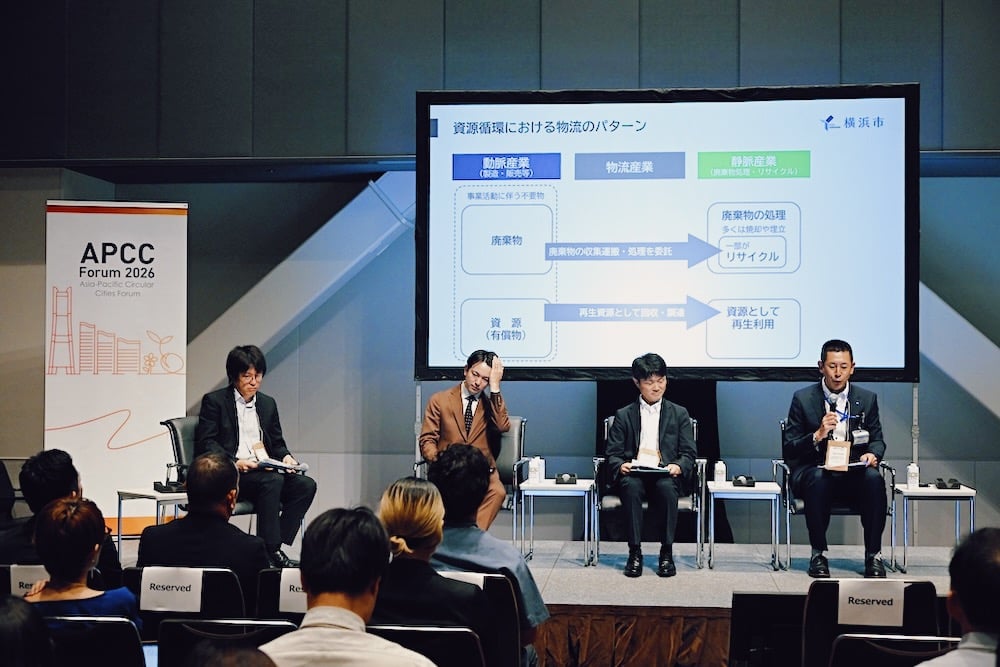
Next, Eito Shirakata (白方栄人) of Nippon Express Co., Ltd. introduced the company’s efforts to build resource circulation logistics. Resource circulation logistics involves more than simply transporting waste and recycled materials. Shirakata explained, “It is essential to understand when, where, how much, and what quality of materials will be generated, and to design optimal logistics routes accordingly.”
In venous logistics, the volume, timing, and quality of resources are less consistent than in arterial logistics, and discharge information is dispersed, making advance planning difficult. Furthermore, legal requirements—such as the permits required under the Waste Management and Public Cleansing Act for transporting waste—impose additional constraints on logistics efficiency. Shirakata noted, “To realize a circular society, it is not enough to focus on arterial logistics alone; advancing venous logistics is critically important.”
As one approach to improving efficiency, he introduced the “milk run” method, in which a single vehicle makes rounds to collect from and deliver to multiple sites. Compared with conventional individual transport, this approach improves load factors and reduces both transport costs and CO2 emissions, while centralized management of transport information also enhances traceability. He explained that understanding resource generation patterns and consolidating collection and information sharing are key to improving venous logistics efficiency.
Supporting this kind of area-level resource circulation from a data perspective is “pool,” a resource circulation data platform developed by Recotec Co., Ltd. Takuki Omura (大村拓輝) of the company introduced a system that connects data from waste generators, collectors, and recycled resource procurers on a single platform, making the flow of resources visible.
pool is currently deployed at approximately 1,200 sites as infrastructure supporting resource circulation in the City of Yokohama. By digitally linking the discharge and collection processes with the municipal management system, the platform has streamlined the data reconciliation work that was previously handled manually by the government. Through integration of weighing data and electronic manifests, the administrative burden of on-site data entry has been reduced by approximately 70%, and the work of reconciling and reporting data has been eliminated entirely.
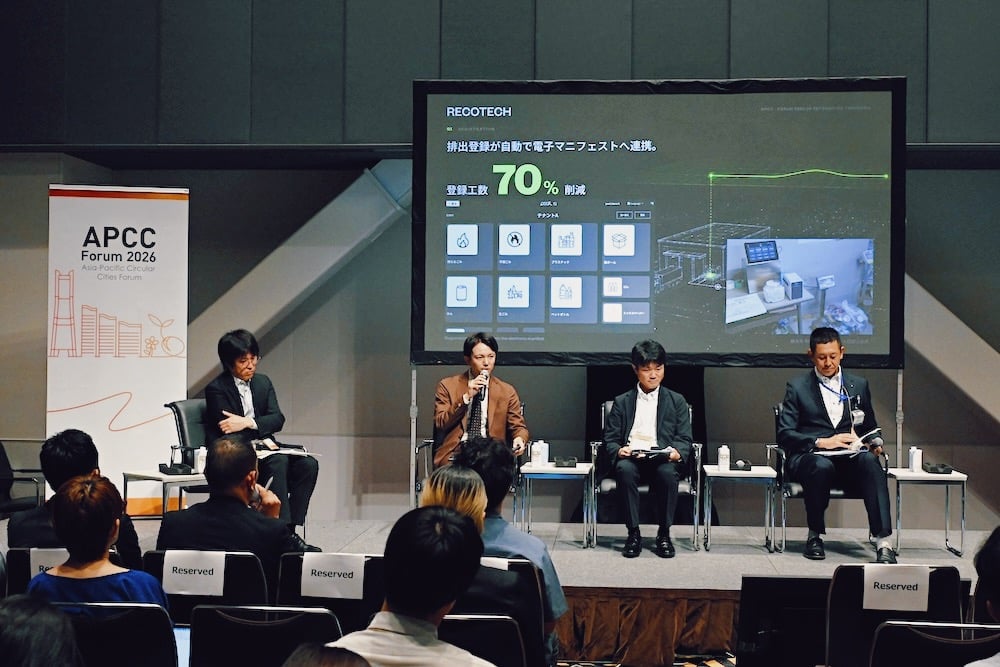
The data platform contributes not only to streamlining administrative tasks, but also to improving collection routes and load efficiency. Omura pointed out that consolidating collection points within a region and increasing area density leads to more efficient logistics and greater economic viability. He noted that local governments, by overseeing the region as a whole and connecting operators, can manage resource circulation at the area level and thereby support the development of sustainable circular systems.
At the close of the session, Oshima reflected that his awareness of the importance of logistics and data infrastructure had grown through ongoing exchanges with companies, including Shirakata and Omura. Inter-company collaboration also creates opportunities for new businesses and circular economy initiatives. He indicated the city’s intention to continue deepening dialogue and engagement with private-sector operators to advance the development of systems that support regional resource circulation.
Toward a Circular City Through Place-Based Policy Design and Public-Private Collaboration
Reflecting on the session as a whole, Shuji Okazaki (岡崎修司) of the City of Yokohama’s Decarbonization and GREEN×EXPO Promotion Bureau identified a common thread running through all three themes—circular architecture, business support, and resource circulation DX—namely, the importance of policy design tailored to the characteristics of each locality.
Whether it is the use of recycled materials and component reuse in public buildings, the formation of supply chains that connect businesses, or the use of digital technology to improve collection and transport efficiency, none of these initiatives can scale through the efforts of individual companies alone. Local governments are called upon to work with operators in light of local conditions and to drive social implementation through the design of policies and programs.
Okazaki emphasized the significance of government participation in projects and its role as a partner in advancing them alongside operators. Beyond the initiatives introduced in this session, the City of Yokohama has a range of other circular economy efforts underway. The city intends to continue deepening collaboration with operators and building systems that leverage the distinctive characteristics of Yokohama as a city.
The challenge is not only to develop technologies and products that circulate resources, but to create the flows through which those resources are used, collected, and returned to productive use within the region. This session brought into focus the role of local government in connecting initiatives across different domains—public procurement, business support, logistics, and data utilization—into coherent local systems. Yokohama’s practice points the way toward building a circular city by steadily accumulating public-private collaboration that draws on the city’s own strengths.
【Reference Article】How Can Local Governments Support the Circular Economy “Market”? The City of Yokohama and Businesses Discuss the Potential of Public Procurement, Business Support, and Resource Circulation DX [APCC2026 Report] | Circular Economy Hub
【Reference Site】Asia-Pacific Circular Cities Forum 2026 (APCC-Forum 2026)
【Related Article】A Circular Economy Starting from Cities: Asia-Pacific Takes Its First Step from Declaration to Action [APCC2026 Report]
【Related Article】Asia-Pacific Tackles Plastic Pollution: The Future of the Global Treaty and Practical Knowledge from Cities and Local Governments [APCC2026 Report]
【Related Article】City-to-City Collaboration Connecting the Asia-Pacific Circular Economy: Where Bangkok, Makassar, and Cebu Stand Today [APCC2026 Report]
【Related Article】What Do Circular Economy-Driven Companies Expect from Cities? Perspectives from the Front Lines of Architecture, Manufacturing, Packaging, and Data [APCC2026 Report]
※This article is reprinted from Circular Economy Hub, operated by Article Inc.