A new creative hub has opened as part of the City of Yokohama’s creative city policy — the first such hub located outside the central waterfront area.
On August 24, 2026, Sta.R (Station R) opened directly connected to Hoshikawa Station on the Sotetsu Main Line. Conceived as a circular culture and creativity hub built around the concept of Creativity × Circularity × Culture, Sta.R is operated by the “Creative Circular City Collective” — a partnership between Article Inc., which runs Circular Yokohama, and Route Design LLC — in collaboration with the City of Yokohama and Sagami Railway Co., Ltd.
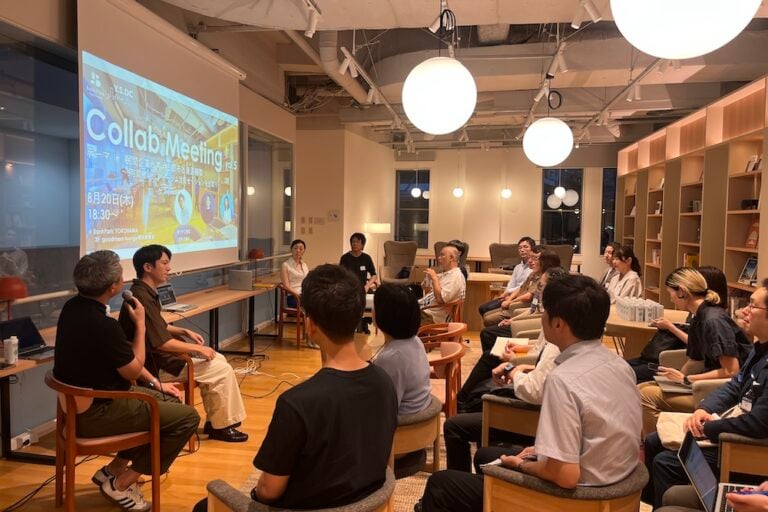
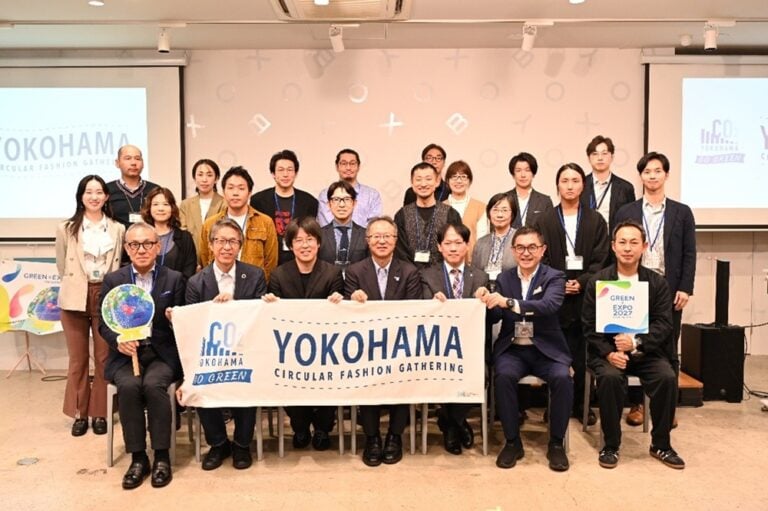
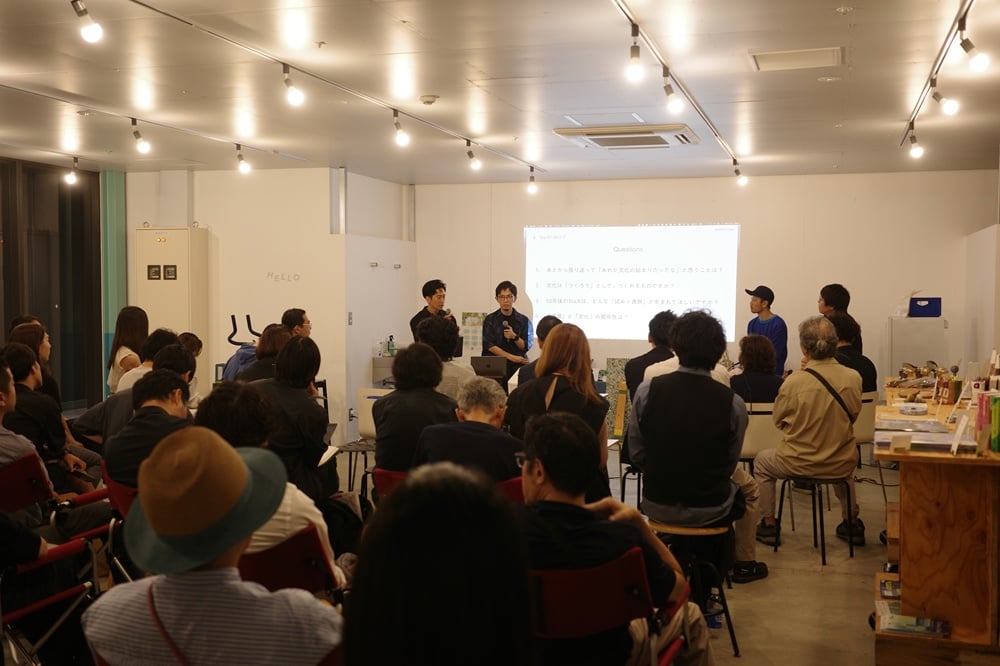
On September 1, a talk event commemorating the opening — titled “Creative Circular City: Envisioning the Future of Yokohama as a Creative City, from the Intersection of Circularity and Culture” — was held. Tetsuro Adachi (Tetsurō Adachi), Director of the City of Yokohama’s Culture, Tourism and Sports Bureau, and Hiroshi Kamibe (Hiroshi Kamibe), Mayor of Hodogaya Ward, delivered opening remarks. Kamibe noted that resource circulation is a major theme of GREEN×EXPO 2027, which opens in March 2027, and spoke about the significance of this hub coming into being before that event. This article reports on the hub introduction and panel discussion that followed.
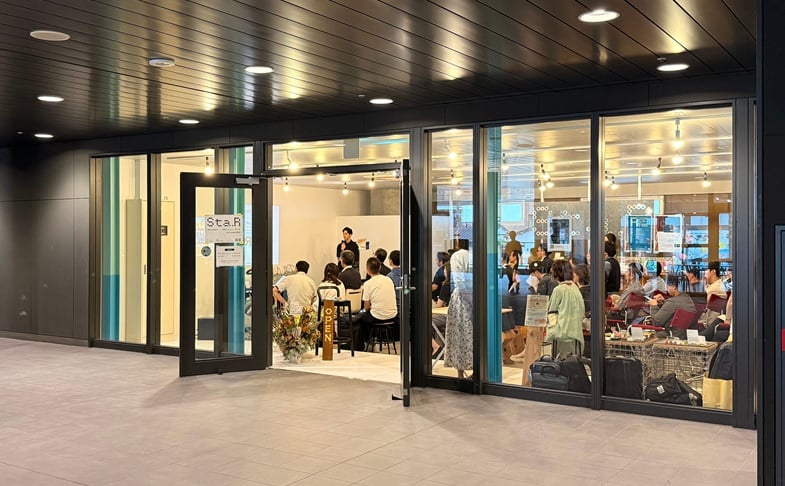
What Is Sta.R, the Circular Culture and Creativity Hub?
Transforming the Station from a “Place You Pass Through” to a “Destination”
The hub was introduced by Yu Kato, Representative Director of Article Inc. Kato opened by referencing news that Yokohama is entering a phase of population decline, saying: “I had been thinking that Yokohama — a city standing at a turning point in history — needs a new kind of civic pride.”
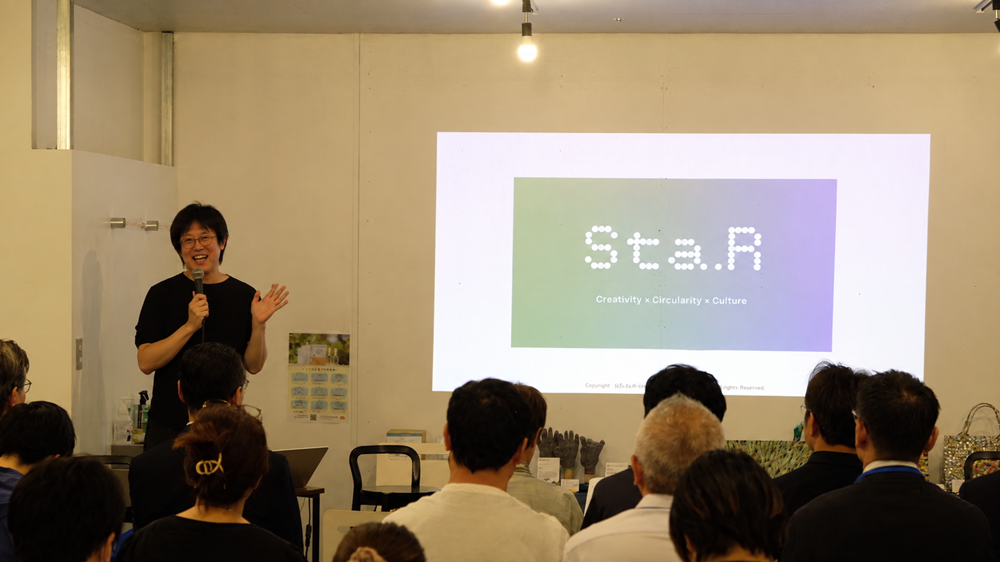
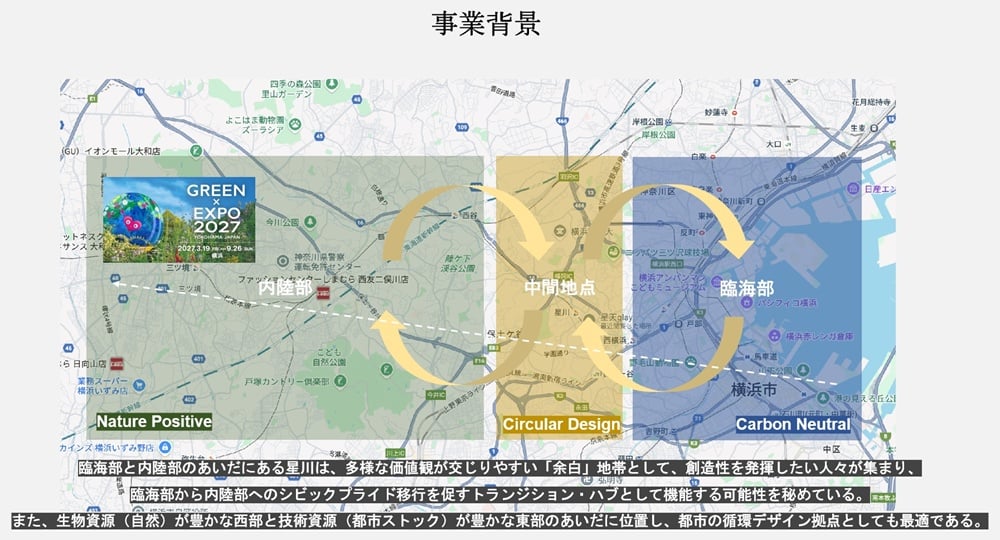
Yokohama’s civic pride has long been tied to the beautiful urban landscape of Minato Mirai. But development along the waterfront is largely complete, and the city’s planning focus is gradually shifting inland. Kato believes the sources of civic pride will shift accordingly.
“In the inland areas, I hope that a new kind of civic pride can emerge — one felt from the inside, through the appeal of everyday life, rather than from admiring a beautiful cityscape from afar. Going forward, people will need not just to enjoy a ‘future’ handed to them, but to feel that they are building their own future with their own hands. When that happens, I thought it might be possible to bring art not only into special, non-everyday spaces (hare), but also into the fabric of daily life (ke).”
Hoshikawa sits midway between Minato Mirai — a designated decarbonization pioneer area — and Kamiseya, the venue for GREEN×EXPO 2027. Kato reflected: “I thought that Hoshikawa, as a place where the culture of the port and the culture of the inland meet, could be somewhere diverse things are born and various cycles set in motion.” As this vision took shape, the concept of a “circular culture and creativity hub” emerged — combining the idea of “circularity” with the city’s creative city policy.
The name layers together the “star” (hoshi) of Hoshikawa, the “station,” and the letter “R” — symbolizing the many forms of circularity: Respect, Reuse, Repair, Remake, Recycle, and more.
“A station is a convenient place, but we want to transform it from a ‘place you pass through’ into a ‘destination.’ By redefining the value of stations for the future, we want to highlight the appeal of the Hoshikawa neighborhood and create a place that shines like a star — all the more beautiful for the darkness around it.”
The space was originally empty and receives little natural light. Kato and his team say they saw potential in precisely those drawbacks.
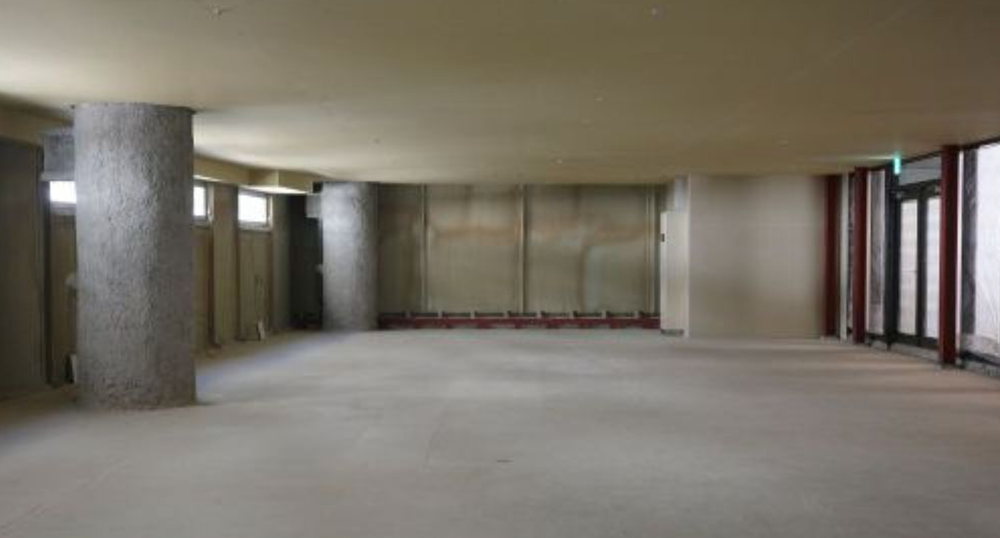
“Finding value in things that are generally considered worthless or difficult to use is essential to realizing circularity. In that sense, rather than a popular location, this place — which had poor sunlight and had sat vacant for so long — felt more true to the concept. That’s when we decided: this is the one.”
Three Functions and a Space Built from Local Circularity
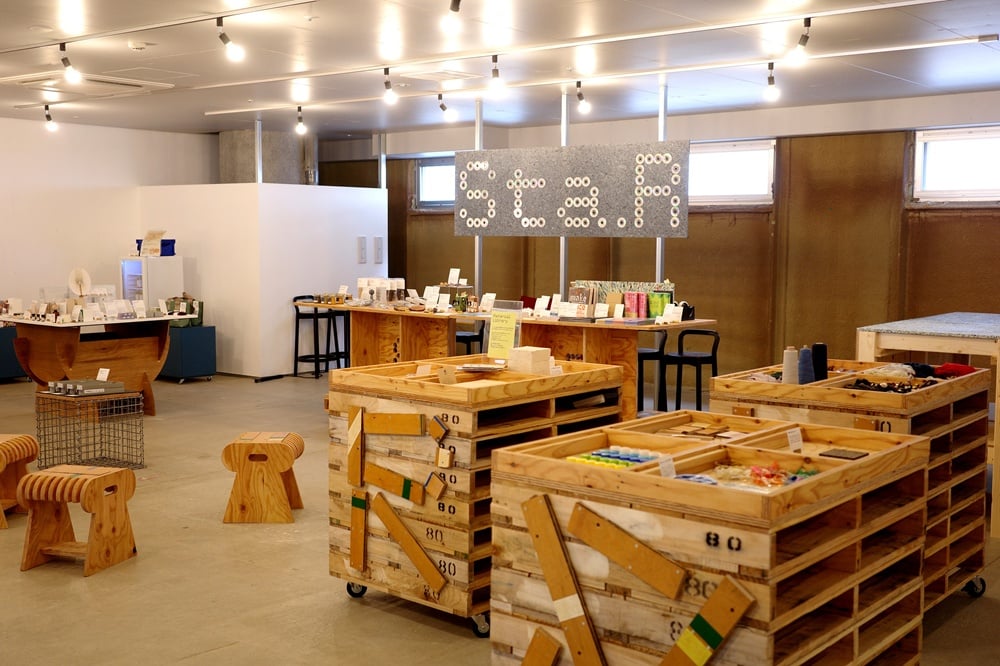
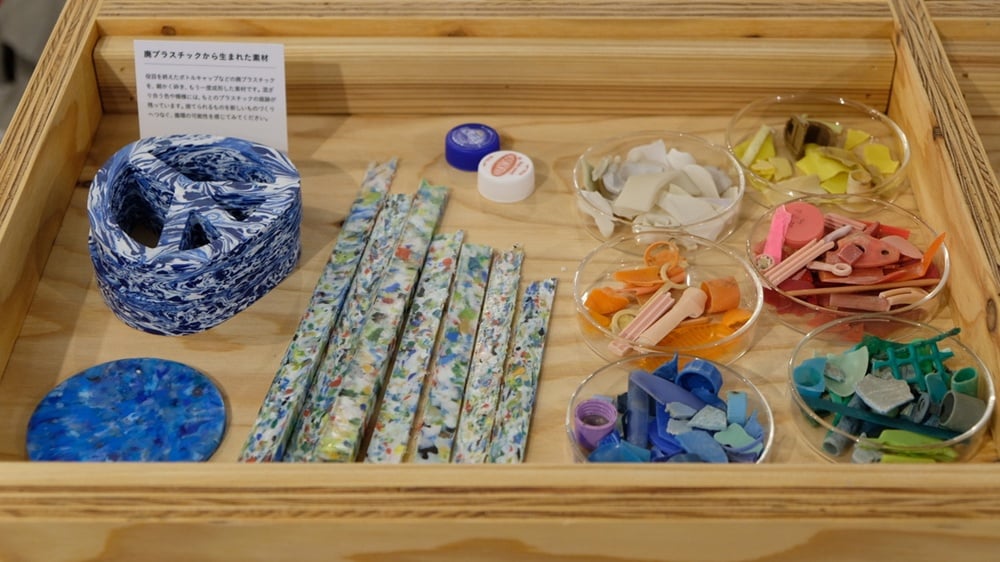
Sta.R has three functions: a “Material Library,” where visitors can encounter materials gathered from the local community; “Я gallery,” a space for viewing and presenting works on the theme of circularity; and “Re:store,” a shop selling goods with a circularity theme.
The space itself is also built from local circularity.
▽Key circular materials used in the space:
- Tabletops made from collected plastic bottle caps (in collaboration with the Sotetsu Group, Hoshiten qlay, and Shonan Boeki Co., Ltd.)
- Curtains made from disused fire hoses collected from within Yokohama (in collaboration with Shimizu Shoko Co., Ltd. and others)
- Deadstock tiles donated by Nikko Co., Ltd.
- Furniture inherited from ELAB, a now-closed Tokyo hub
- Gymnasium flooring removed during renovations at a Yokohama city elementary school
- Reuse glass collected in Suwa, Nagano Prefecture, donated by AGC Inc.
- A fiber-recycled board made from collected clothing and a sign board incorporating secondhand CDs (in collaboration with GREEN FLAG)
The space was designed by ON design partners Co., Ltd. and constructed by Fukuzawa Co., Ltd.
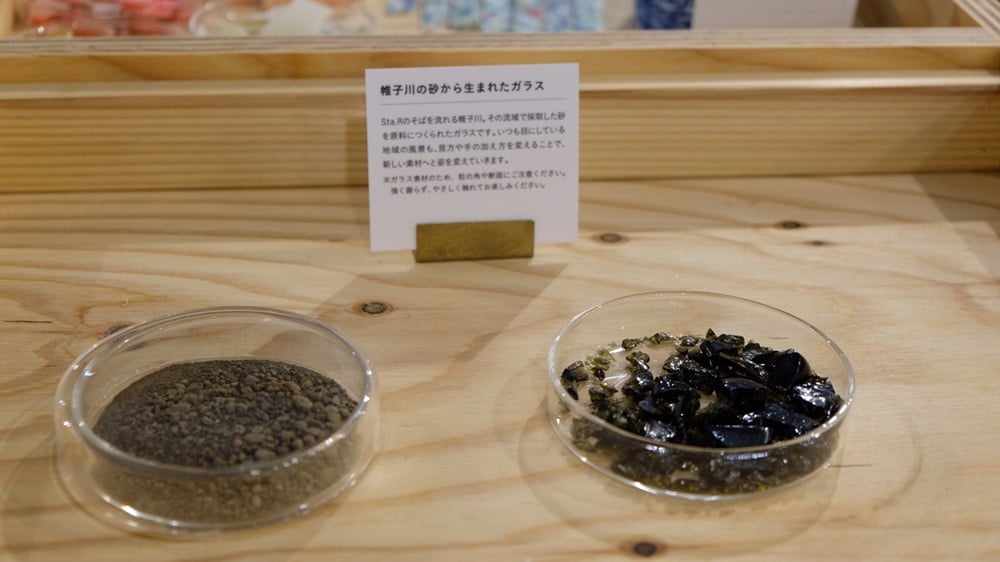
Among the most symbolic elements is glass made from sand collected along the Katabiragawa River. A connection formed through another creative hub, BankPark YOKOHAMA, gave rise to a group called “Team Katabiragawa,” whose members gathered sand from the river, which was then used to produce glass with the help of members from AGC Inc. Because the mineral content of sand varies by location, the color of the resulting glass also differs from place to place.
“Transparent glass lets you see through it, but reveals nothing of the story of the land it came from. Colored glass is harder to see through, but the story of the land becomes visible. This glass redefines what it means for glass to be ‘see-through’ — its very value.”
Kato closed by saying, “Sta.R is just a starting point. We want to create places like this not only here, but across all of Yokohama,” and outlined a vision for similar hubs to emerge in vacant homes and housing complexes throughout the city.
Part 1: “Creativity × Circularity — How Can Sta.R Create Circularity?”
▽Panelists:
Daisuke Sonoda (Daisuke Sonoda), Section Chief, Creative City Promotion Division, Culture, Tourism and Sports Bureau, City of Yokohama
Osamu Nishida (Osamu Nishida), Representative, ON design partners Co., Ltd.
Yoshio Tsuda (Yoshio Tsuda), Representative, Route Design LLC / Managing Representative, PILE -A collaborative studio-
▽Moderator:
Yuko Nagano (Yūko Nagano), Chief Design Officer, Article Inc.
Why the Creative City Policy Is Expanding to the Suburbs
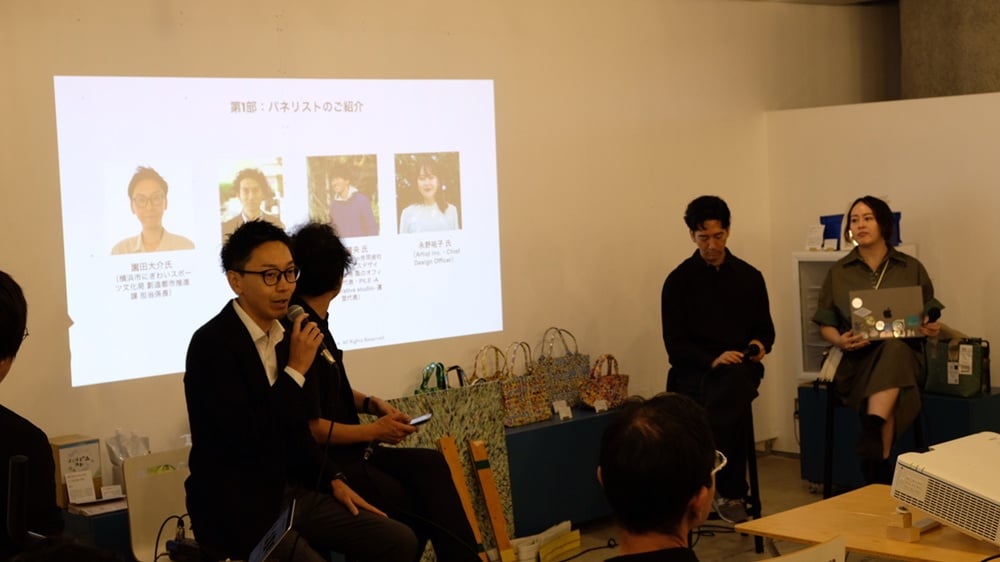
The first topic was: “Why is the creative city policy expanding beyond the central waterfront area?” According to Sonoda, the City of Yokohama’s creative city policy began about twenty years ago in the Kannai district, which had been losing vitality as office vacancy rates rose. The idea was to harness the power of art and creativity. The approach involved preserving historic buildings and inviting artists and creators to use them in imaginative ways — and the resulting spaces became the city’s creative hubs.
While activity along the waterfront has grown increasingly vibrant, population decline and an aging society have created a situation in which the future of local communities risks becoming unsustainable. Sonoda described the background to his push, begun about three years ago, to expand the policy into suburban areas.
“I had been thinking that the approaches the creative city policy has developed over the past twenty years might also be applicable in suburban communities — that they could help address local challenges.”
What came into focus was a section of the second floor of Hoshiten qlay designated for administrative use. It was a space that various departments had been aware of but unable to decide how to use.
What Does It Mean to Design with Existing Buildings in Mind?
The next topic was: “Can circularity be designed?” Nishida, who led the design of Sta.R, introduced his approach to working with existing buildings. When modifying an older structure, a designer must decide what to demolish and what to leave intact. Nishida described this design philosophy — thinking not only about what to tear down, but about “how much to preserve and make use of” — as “something that will be needed a little sooner than Japan’s current sensibilities might suggest.”
In designing Sta.R, both what could be built and where interventions could be made were limited. Within those constraints, Kato proposed using deadstock tiles. Nishida recalled being struck by the shift in thinking: using what had gone unused, and activating a space that had been left dormant. He also spoke highly of the current state of the space — deliberately left unfinished, with room for new things to emerge.
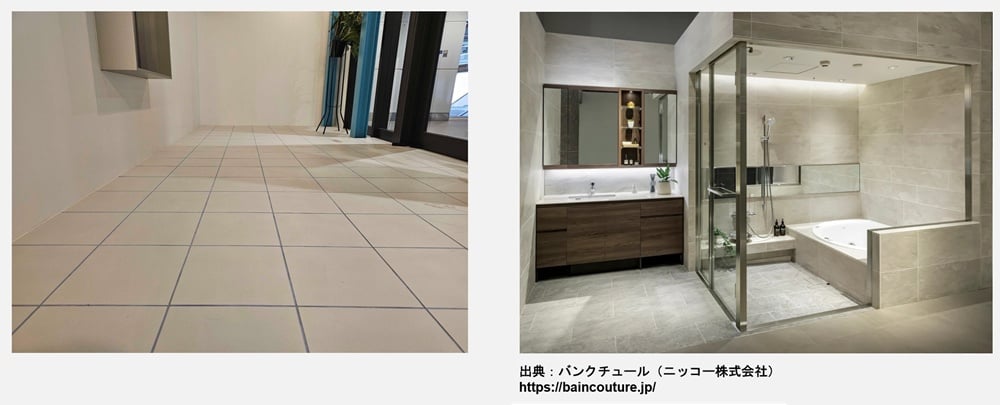
Nagano, who served as art director for Sta.R, responded that precisely because Sta.R is unfinished, team members who weren’t directly involved in the construction come to the space and spontaneously offer ideas — “Can we do something with this?” — and that she finds that wonderful. Building on this, the panel suggested that leaving things at “we’ll figure the rest out together from here” might be exactly what makes people feel a sense of personal ownership over the space.
Nagano touched on the concept of bricolage — making do with what’s at hand — and said that at Sta.R, an attitude of “if something becomes waste, let’s see what we can do with it” has naturally taken hold. Nishida added: “Some of the materials at Sta.R would not be treated as materials at all in other contexts. It’s a very good thing that more people are developing the sensibility to find value in them.”
Toward a “Creative Circular City”
According to Sonoda, the creative city policy has always been rooted in activating buildings that have fallen out of use. He noted that Sta.R’s efforts to find new life in unused and discarded things connect directly to the philosophy of the creative city.
“I’ve found myself starting to say: maybe instead of a ‘Creative City,’ we should be talking about a ‘Creative Circular City.’ We currently use the term ‘creative city,’ but I genuinely feel that the momentum is there to add ‘circular’ to it.”
When Tsuda pointed out that previous creative hubs had primarily been spaces for makers — artists and the like — Sonoda responded that future hubs would be closer to everyday life, stimulating living culture, and that Sta.R could be a pioneer in that direction. The hope is that residents bringing in unwanted items will create new points of connection with the hub.
Nagano offered an early sign of this: at a July workshop on repurposing disused fire hoses for disaster preparedness, a woman from the neighborhood took home a substantial quantity of hose. Nagano reflected that it felt as though a local resident had become involved not just as a user, but as a maker.
Tsuda, drawing on his experience running the coworking space PILE, said that the theme underlying the circulation of materials is ultimately about human relationships. Encounters lead to collaboration, which spreads through the community — and he said he hopes to see that same cycle take hold at Sta.R.
What We Hope for in Ten Years: “Things We Can’t Yet Imagine”
The final topic was: “What would need to have happened in ten years for us to say that ‘circularity has taken root’?” Tsuda said he hoped that people who met here would have gone on to build something even greater ten years from now, and that new hubs would have been born — all as “the result of a cycle of human connection.” Sonoda prefaced his remarks by noting they were his personal views rather than an official position, then shared the following:
“Is what we can imagine right now truly interesting? Perhaps what’s actually most exciting is the possibility of things rolling off in directions we never anticipated.”
Part 2: “Creativity × Culture — How Can Sta.R Create Culture?”
▽Panelists:
Kei Fujieda (Kei Fujieda), Co-founder and Representative Director, Cultars (general incorporated association) / Representative Director, Banryu Co., Ltd.
Taro Yasuzawa (Tarō Yasuzawa), Co-founder and Director, Cultars (general incorporated association) / Representative Director, Koinobori Co., Ltd.
Yu Kato (Yū Katō), Representative Director, Article Inc.
▽Moderator:
Yoshio Tsuda (Yoshio Tsuda), Representative, Route Design LLC / Managing Representative, PILE -A collaborative studio-
Culture Appears in the Everyday
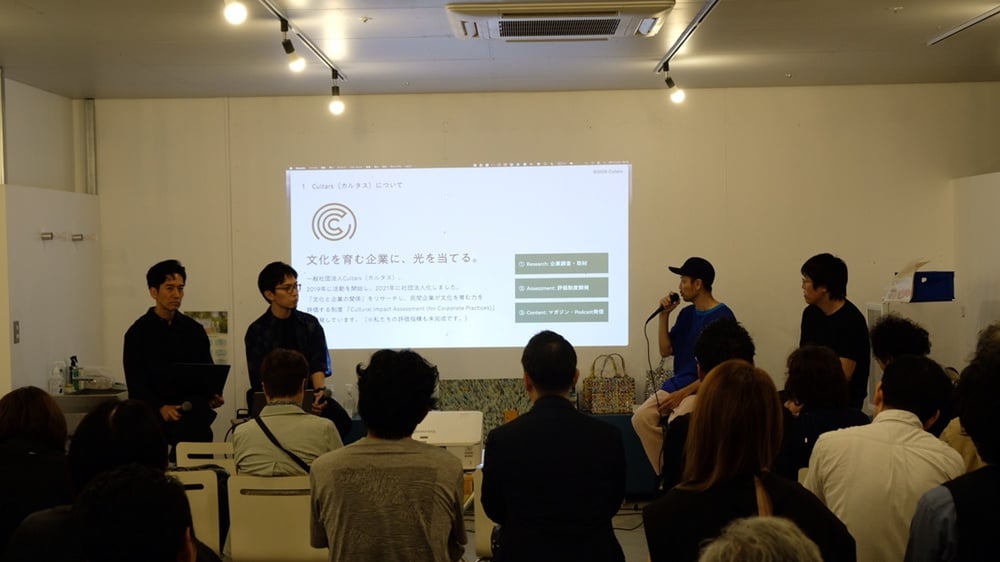
Moderator Tsuda opened by saying that “culture” is a word that can slip by too easily, and that he wanted to pause and think about it carefully. Fujieda, from Cultars — an organization developing frameworks for evaluating the cultural activities of companies — displayed a slide listing around two hundred phenomena: greetings, graffiti, New Year’s cards, and more, and posed a question to the audience.
“Which of these would you call ‘culture’?”
Fujieda offered one perspective. When people think of culture, they often cite kabuki or the tea ceremony — but in reality, isn’t culture much broader than that? His view is that culture is something people give meaning to, shape into a form, and spread through repetition — and by that definition, all of the phenomena on the slide could be called culture. Culture, he argued, is not something that exists only for special people; it appears in the fabric of everyday life.
Culture Is Nurtured by “Attempts” — and by Encouragement
So how is culture cultivated? Cultars has developed a working hypothesis that organizes the process of cultural formation along two axes — intentional vs. unintentional, and repetition vs. deviation — into four categories. There is the “form” (kata), which involves intentional repetition, as in the etiquette of the tea ceremony; the “habit” (narai), which involves unconscious repetition, as in greetings or dialects; the “slip” (hokorobi), which involves unintentional deviation, as in a mispronunciation; and the “attempt” (kokoromi), which involves intentional deviation. Creating new festivals or spaces like Sta.R falls into the category of “attempts.” Fujieda proposed that new culture begins with these “attempts” — but added that attempts alone are not enough.
“What matters is not just making the attempt. Accepting, encouraging, and affirming the attempt — the deviation — is, I think, enormously important. Without that, an attempt will probably never be repeated enough to become culture.”
The example he gave was EarthQuaker Devices, an American effects pedal manufacturer. An employee who identified as an artist began drawing pictures of cats on the back panels of products without permission. The company president allowed it and began shipping the products as-is, and the cats eventually became beloved by fans. Fujieda reflected: “I thought this was a moment when culture was being born — in that act of deviation.”
There is often pressure to demonstrate ROI (return on investment) when it comes to culture, he acknowledged. While that is understandable, he argued that it is vital to incorporate freedom, playfulness, and a tolerance for deviation into the early “cultivating” phase — the soil and roots, so to speak. Yasuzawa also noted that outcomes tend to receive disproportionate attention, saying: “I want to be more conscious of the ‘cultivating’ part, not just the results.” Fujieda then connected the discussion to the etymology of the word.
“The word ‘culture’ comes from ‘cultivate’ — to till the soil. If we’re not paying attention to the soil, what exactly are we paying attention to?”
Building a Society Where “Mixing Is Allowed”
In the discussion, Tsuda suggested that the employee who drew the cats was probably able to do so because colleagues were around.
“If we think of new attempts as emerging from the encounter and mutual stimulation between people, then the coming together of people seems absolutely essential.”
Kato then shared something that had happened at Sta.R shortly after it opened. One Sunday, a young child who had come with their mother reached into the Material Library display — where materials had been sorted by color — and began mixing them together. Kato watched, inwardly wondering whether he would have to tidy everything up afterward, but gradually came to understand what the child was doing.
“For that child, they were cooking. The petri dish was a plate, the wood-colored material was cheese, and the gaps in the palette were the oven.”
After about five minutes, the child began handing out the “dishes” to the staff.
“Watching that, I thought: maybe ‘mixed it’s waste, separated it’s a resource’ isn’t the whole story. For a child, there’s no distinction between waste and resource to begin with. Perhaps what’s truly important is building a society where mixing things together is allowed.”
In the child’s imagination, the materials had become food. Kato said that this way of being — seemingly making a mess, yet creating something — might be exactly the kind of creative circular culture that Sta.R should aspire to.
Fujieda resonated with this, saying that in moments when the instinct is to impose rules, “observation and encouragement” are what matter most. If you keep observing, you begin to see the value in what is happening — and from there, you can rethink the rules.
Rather than regulating, observe and encourage. Taking up Fujieda’s thought, Tsuda closed Part 2 by saying: “We too want to keep making attempts and embracing deviations here at Sta.R.”
Editor’s Note
This commemorative event brought together practitioners from different fields — local government, architecture, community management, and cultural research.
What came up again and again was the idea of changing how we see things that have been considered without value. A dim corner of a station. Waste materials that wouldn’t be treated as materials anywhere else. Colored glass that’s hard to see through. Materials mixed together by a child. In each case, a shift in perspective transformed them into a hub, into furnishings, into the story of a place, into something of new value.
Circular approaches to urban development are often discussed in terms of sorting systems and recycling infrastructure. But the conversation that day turned its attention to something more fundamental: the way we look at things, and the presence of people who find attempts worth cheering on. What comes into view from there is that circularity is not only about resources and materials — it is also about human relationships and the culture of everyday life. That, it seems, is where the meaning lies in the convergence of creative city policy and circularity in Hoshikawa.
In an unfinished hub born in a corner of a station, the attempts and encouragement of local people will accumulate, one by one. And from that, perhaps, a circular culture that is distinctly Yokohama’s own will take root and grow.
【Related site】Sta.R (Station R)
【Related site】Coworking space “PILE“
【Related site】Cultars (general incorporated association)
【Related site】Creative Hubs